
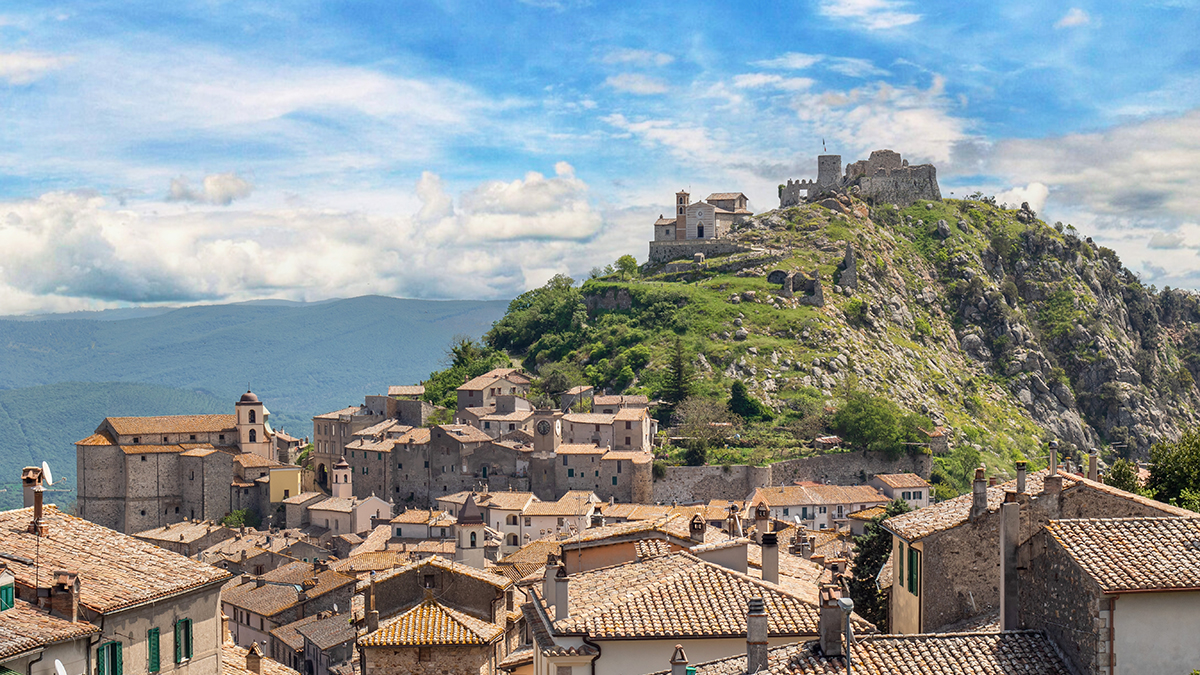
Tolfa: The Undiscovered Medieval Village Near Civitavecchia
Drive inland from Civitavecchia port and within ten minutes the sea is gone. The road climbs through oak woods and open pasture where long-horned grey cattle graze, and then a strange shape fills the windshield: a steep cone of volcanic rock with a ruined castle on top and a town fanned out below it. That is Tolfa, a medieval village about 20 km from Civitavecchia that most cruise passengers never hear about, even though it sits closer to their ship than Rome's traffic does.
This guide covers what to see in Tolfa village, how to get there from Civitavecchia or Rome, and how to fit it into a port day without watching the clock.
Where Tolfa Is and How to Get There from Civitavecchia
Tolfa lies in the Monti della Tolfa, a range of old volcanic hills between Civitavecchia and Lake Bracciano. By road it is roughly 20 km from the port, which means 25–30 minutes by car along the provincial road toward Allumiere and Tolfa. From central Rome it is about 70 km, usually 75–90 minutes via the A12 motorway to the Santa Severa exit and then a winding country road.
| Option | Time from Civitavecchia | What to know |
|---|---|---|
| Cotral regional bus | 35–45 minutes | Cheap (a few euros), but departures run roughly every one to two hours. A missed return bus can cost you your all-aboard margin. |
| Taxi | 20–25 minutes | Easy one way; finding a taxi back from a small hill town is not guaranteed. |
| Private driver | 25–30 minutes | Waits for you in Tolfa and brings you back to the ship on a fixed schedule. |
The bus is a genuine option for independent travelers staying overnight in Civitavecchia. On a cruise day, the return leg is the weak point: public transport in the hills keeps its own timetable, not your ship's.
What to See in Tolfa Village
Rocca dei Frangipane and the Madonna della Rocca
The castle ruins on the summit belonged to the Frangipane family, who settled in the area in the 14th century. To reach them, take Via della Rocca, a stepped lane that climbs steadily past small gardens and stone houses. It is uphill all the way and takes 15–20 minutes at an easy pace. Wear shoes with grip.
At the top you get the reason people make the climb: a 360-degree view over wooded ridges, the Mignone valley and, on clear days, the Tyrrhenian coastline. Next to the ruins stands the small church of the Madonna della Rocca, the oldest in Tolfa. Access to the ruins is free, though parts of the site are sometimes fenced off, so treat the interior as a bonus rather than a promise.
Piazza Vittorio Veneto and the Old Town
Locals call it Piazza Nuova. Its long balcony looks east over the countryside, and on a clear morning you can pick out the Apennines on the horizon. From here, the lanes of the centro storico run downhill in a tangle of arches and steps. Tolfa is a working town of around 5,000 people, not a museum set, so expect laundry on balconies, men arguing outside the bar and very few souvenir stands.
Museo Civico: Etruscans and the Alum That Made Tolfa Rich
The civic museum occupies a 16th-century former Augustinian convent next to the sanctuary of Santa Maria della Sughera. Its collection runs from Bronze Age and Etruscan finds from the surrounding hills to the story that shaped the town: in the 1460s, deposits of alum were found here. Alum was essential for dyeing cloth and tanning leather, and the papal mines at Tolfa and neighboring Allumiere became one of the Church's most profitable monopolies. That money built the churches and palazzi you walk past. Check opening hours with the Polo Culturale before you go, since they vary through the year.
The Catana: Tolfa's Leather Bag
If the name Tolfa rings a faint bell, it is probably because of a bag. The catana is a simple leather shoulder satchel whose local tradition is usually dated to 1575. Shepherds and butteri, the mounted cattlemen of this part of Lazio, carried their bread and tools in it. In the 1970s it became the unofficial bag of Italian students, and it has drifted in and out of fashion ever since.
Several family workshops still cut and stitch catane in town. Stepping inside one, with the smell of tanned hide and the sound of a mallet on leather, is the most memorable souvenir stop in the area, and you buy directly from the person who made the piece.
Butteri, Cattle and Lunch
The hills around Tolfa are cattle country. The grey Maremmana cows with their lyre-shaped horns and the sturdy Tolfetano horses are the reason the butteri tradition survives here, with riding tournaments in summer. That pastoral heritage shows up on the plate: grilled beef, cured prosciutto from the hills, and acquacotta, a bread and vegetable soup that fed shepherds for centuries. Order the house wine, ask what the kitchen made that morning, and let lunch run its course.
Planning Tolfa on a Cruise Day
Tolfa fits comfortably into a port stop of six hours or more. A realistic plan for a ship docked from 8:00 to 18:00:
That leaves hours of margin before a typical all-aboard time. If your ship is in port for a shorter window, skip the museum and keep the Rocca and the old town. Staying in Civitavecchia instead? Our walking guide to Civitavecchia covers everything within reach of the terminal, and the Complete Civitavecchia Port Guide explains how the port works. The Port Mobility info point at Largo della Pace can also help with local bus times.
Reach Tolfa Comfortably with a Private Driver
Reach Tolfa comfortably with a private driver from Civitavecchia or Rome. TK Limo Service picks you up at the cruise terminal with a name sign, waits while you explore, and has you back at the ship well before all-aboard. Fixed price confirmed at booking, tolls included, Mercedes E-Class or S-Class for up to 4 passengers and V-Class for up to 7.
Frequently Asked Questions
How far is Tolfa from Civitavecchia port?
Tolfa is about 20 km inland from Civitavecchia port, a 25–30 minute drive along the provincial road that passes Allumiere. Regional Cotral buses also connect the two towns in 35–45 minutes, but they run only every one to two hours, which makes timing a round trip on a cruise day harder.
Is Tolfa worth visiting on a cruise stop?
Yes, especially if you have already seen Rome. In four or five hours you can climb to the Rocca dei Frangipane, walk the old town, visit a leather workshop and have a long lunch, all without the crowds and the 80 km drive of a Rome day. It suits travelers who prefer real towns to headline sights.
Can I visit Tolfa from Rome?
Yes. Tolfa is roughly 70 km from central Rome, about 75–90 minutes by car via the A12 motorway and the Santa Severa exit. There is no direct public transport, and bus connections involve changes, so a car or private driver is the practical choice for a day trip from Rome.
What is Tolfa famous for?
Tolfa is known for the catana, a handmade leather shoulder bag, for the ruins of the Rocca dei Frangipane on its volcanic hill, and for its history as a papal alum-mining center from the 1460s. The surrounding hills are also home to the butteri, the traditional cattlemen of this part of Lazio.
How difficult is the walk up to the Rocca dei Frangipane?
The climb via Via della Rocca is steep and uphill all the way, but short: about 15–20 minutes at a relaxed pace from the old town. Comfortable shoes with grip are essential. Travelers with limited mobility can still enjoy the wide views from Piazza Vittorio Veneto, which requires no climb.
Can I combine Tolfa with other places near Civitavecchia?
Yes. Allumiere, the neighboring alum-mining town, is on the same road and makes a short add-on. With a full day in port, Tolfa pairs well with the Terme della Ficoncella hot springs on the way back, or with Tarquinia's Etruscan tombs for travelers interested in history.